Children’s Hospital opens a 17-bed area for “colored children,” called the James G. and Margaret L. Butler Ward. Image: In the Butler Ward, St. Louis Children’s Hospital, circa 1923
1923: SLCH opens ward for “colored children”
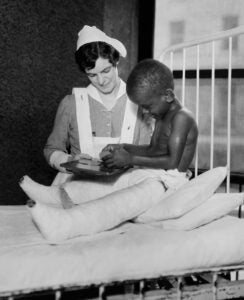


Children’s Hospital opens a 17-bed area for “colored children,” called the James G. and Margaret L. Butler Ward. Image: In the Butler Ward, St. Louis Children’s Hospital, circa 1923
St. Louis passes an $87 million bond issue, with $1 million earmarked for a hospital that would care for Black patients. A dispute soon rages over whether the hospital should be free-standing or an adjunct to the white City Hospital #1. Black advocates, including attorney Homer G. Phillips, press hard for a separate Black hospital […]
The City Hospital #2 for Black patients is so congested that patients are often put in beds in hallways. Some patients are shifted to People’s Hospital, the private Black hospital, and the city is charged a daily rate for their care.
Black patients are transferred from overcrowded, segregated wards at City Hospital #1 to the newly opened Black public hospital, City Hospital #2, at Garrison and Lawton.
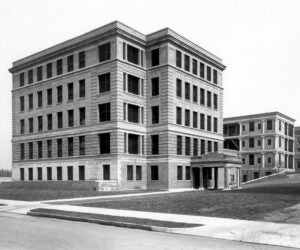
St. Louis Children’s Hospital opens a new Central West End building as a segregated facility. Four years later, it begins sending Black pediatric patients to Barnes Hospital’s adult “Colored Ward” for treatment. Image: St. Louis Children’s Hospital, 1915
Barnes Hospital opens. Its outpatient clinic treats Black patients, but Black hospital patients are admitted to segregated care in two adjacent houses. One room in the Barnes Emergency Division is designated for Black surgical and obstetrical patients. Image: Washington University Medical Campus, 1915. Care for Black hospital patients is restricted to the two houses, seen […]
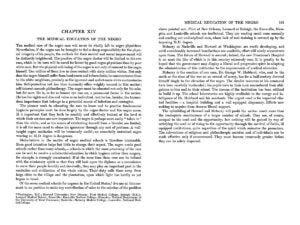
The Flexner Report on Medical Education scolds poorly run medical schools and leads to the closing of many. On Abraham Flexner’s recommendation, Meharry Medical College and Howard University College of Medicine are the only two historically Black medical schools that survive the initial wave of closings. “[T]he physical well-being of the negro is not only […]
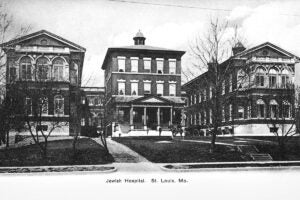
The Jewish Hospital of St. Louis opens on Delmar Boulevard and soon admits Black patients to its outpatient clinic, though not to the hospital. It moves to Kingshighway Boulevard in 1926. Image: Postcard, Jewish Hospital, circa 1913.
The U.S. Supreme Court decides the landmark Plessy v. Ferguson case. It rules that segregation laws do not violate the U.S. Constitution as long as the facilities for each race are equal in quality. It becomes known as the “separate but equal” decision, spawning the “Jim Crow” laws that bar Black people from sharing public […]
Provident Hospital, later People’s Hospital, is founded as a 75-bed private Black hospital in St. Louis.