1973: LaFrances Cockrell: First Black nurse to hold administrative responsibilities
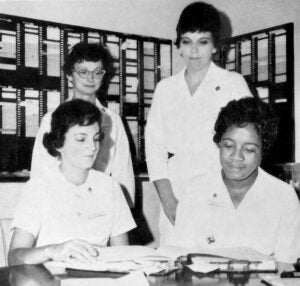
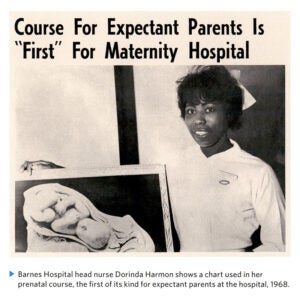
LaFrances Cockrell, right, pictured in the Barnes Hospital Bulletin, December 1965

Nurse LaFrances Cockrell is named the associate director of nursing at Barnes Hospital, overseeing obstetrics and gynecology, nurseries and the otolaryngology divisions, making her the first Black nurse at Barnes to hold administrative responsibilities. Image: LaFrances Cockrell, right, pictured in the Barnes Hospital Bulletin, December 1965

ca 1965: Board of Trustees officially integrates Barnes Hospital

The Barnes Hospital Board of Trustees officially integrates the hospital. Its resolution explains: “RESOLVED, it is the policy of Barnes Hospital to operate without racial discrimination. This policy applies to persons served by Barnes, to its staff, and to membership on its governing board. Operating without discrimination means that: (1) No person is excluded from […]

“In 1964, Barnes Hospital was recently integrated, and I was an intern, working with Dr. [Eugene] Bricker. He had a patient — a white man — who was scheduled for an operation. The patient said, ‘I’m not willing to be in this room with that person,’ pointing at the African American man in the other bed. ‘I’m not used to sharing a room with a Negro.’

“Dr. Bricker said, ‘You know, you’re absolutely right. You need a new room; in fact, you need a new hospital, and a new surgeon. I’ll call your referring doctor and tell him.’ He might as well have said that over the loudspeaker. It was astonishing because in those days there were testy moments. But Dr. Bricker was God, and as soon as he said that, integration was accomplished.”

— Bernard Jaffe, MD

1960s: Charles Carroll becomes leader, teacher for trainees

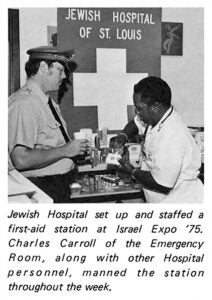
Charles Carroll

Charles Carroll, an Emergency Room orderly at Jewish Hospital, develops skills far beyond his job description. Generations of medical students and trainees learn from him. “As the years went by, my colleagues and I came to rely on Mr. Carroll. He could read X-rays way beyond our skills. It became a bellwether of evaluation for […]

Early 1960s: Medical students fed up with segregation

On one Christmas Eve, a group of medical students, fed up with segregation at Barnes Hospital, move beds around so that one ward “was like piano keys: Black, white, Black, white,” recalled Gerald Medoff, MD.

1958: Jane Ervin: First Black nurse at SLCH

Jane Ervin becomes the first Black nurse at Children’s Hospital, working there for five years. Her husband, John B. Ervin, is the first Black dean on the Danforth Campus at Washington University.

1958: Black surgeons given faculty status, hospital admitting privileges

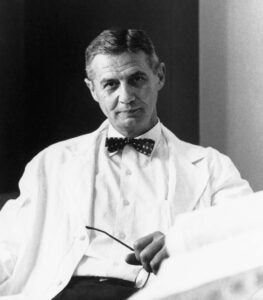
Carl Moyer, MD

Carl A. Moyer, MD, head of Washington University Surgery, gives faculty status or Barnes Hospital admitting privileges to Black Homer G. Phillips surgeons Frank Richards, MD, William Sinkler, MD, and others.  “Dr. Moyer was a terrific guy, very interested in Homer Phillips. The only way I got into the St. Louis Surgical Society was that […]

1955: Psychiatric hospital integrates

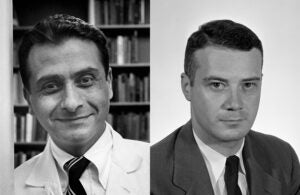
Renard Hospital, the psychiatric hospital, integrates after white psychiatrists Samuel Guze, MD, and George Winokur, MD, quietly begin admitting Black patients. Samuel B. Guze oral history audio recording available via Bernard Becker Medical Library Archives » Images: Samuel Guze, MD | George Winokur, MD  

1955: Homer E. Nash Jr., MD, joins SLCH medical staff

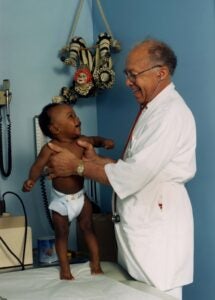
Homer E. Nash Jr., MD, was “a consummate educator and renowned clinician whose name is synonymous with compassionate care. … He was a constant advocate for his patients, and they adored him,” writes the St. Louis American, June 4, 2022.

Black pediatrician Homer E. Nash Jr., MD, joins the Children’s Hospital medical staff, after earning his medical degree at Meharry Medical College and performing residency training at Homer G. Phillips Hospital. He dedicates his 46-year career to providing care to children in North St. Louis, many of them poor and underserved. He wins Children’s Hospital’s […]